Don't automate a mess: Audit, Optimize, Automate, Verify
Corey Ganim's AOA framework, Audit, Optimize, Automate, is a simple rule for bringing AI into a business. A fourth step, Verify, is the one most owners skip, and it's the one that protects your customers.
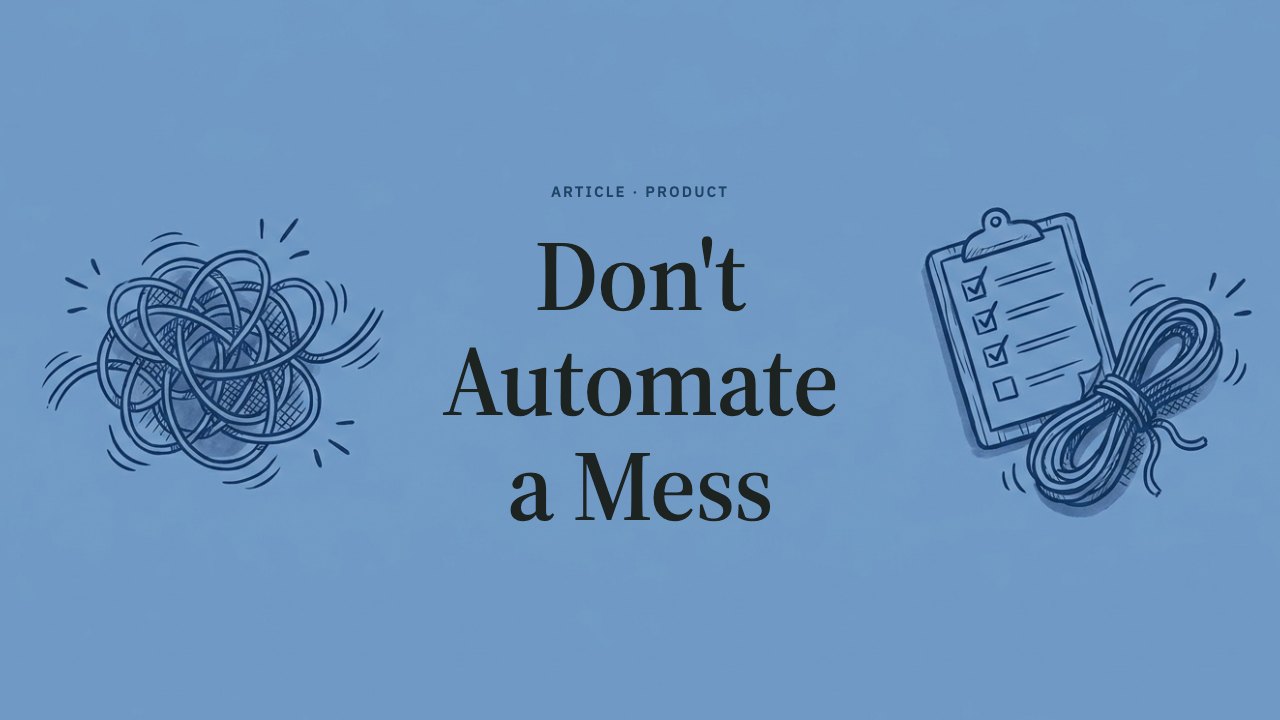
You buy an AI tool to "handle enquiries" or "do the follow-ups", point it at the way things work today, and get the same mess back, only faster. Michael Hammer warned about exactly this in Harvard Business Review in 1990, when companies were using computers to speed up broken processes: "It is time to stop paving the cow paths.
The clearest fix I've found comes from Corey Ganim, who teaches AI services to consultants and operators. His framework is three words long: Audit → Optimize → Automate. Diagnose the process first, simplify it second, and automate only when the economics justify it.
I use it on client engagements. But after years of building systems that run without me watching, I add a fourth step, because that's where my own mistakes have happened.
Audit: find out what actually happens
Not what the process is supposed to be. What really happens, where time goes, and where money leaks.
Optimize: fix the process before you touch AI
Remove steps, clarify rules, and decide who owns what. Many problems disappear here, for free.
Automate: only the parts that repeat and pay
Give AI the narrow, repetitive work with a clear rule and a measurable benefit.
Verify: check the machine's work, forever
Something other than the thing that did the work checks it, before a customer sees it. This is my addition.
Step 1: Audit, because the problem is rarely where you think
When I connected Google Ads to its API for The Modern Shrine, I was trying to answer a simple question about which searches converted. The audit found something much bigger: one of my purchase-tracking settings had been recording every plan sale as a flat $1, and the original purchase actions for the career product had recorded zero conversions in their entire history. For about five weeks, from about 22 July to 25 August 2026, Google's automated bidding was working toward that flat $1 value instead of the real one.
No amount of automation would have fixed that. It would have spent my budget faster on the wrong goal. The full story is here.
An audit doesn't need to be elaborate. For a small business I look at three things:
- Where the hours go. Which tasks repeat every day or week, and who does them.
- Where money leaks. Missed enquiries, slow quotes, forgotten follow-ups, wrong numbers.
- What "done right" looks like. If nobody can describe a good outcome, AI can't produce one.
Step 2: Optimize, the step everyone wants to skip
The clearest lesson I've had on this came from a workshop with two independent insurance advisors. They wanted all their product and client knowledge searchable with AI, and we went straight to setting up tools. We never agreed which questions mattered or which documents answered them. Seventy minutes later we had a beautiful knowledge graph and no proof it could answer a single real question. I wrote up what went wrong.
We had skipped Optimize. The fix wasn't a better tool. It was deciding, before anything was installed, that the first version would hold the 5–10 documents that answer the questions clients ask every week.
Optimizing usually means:
- Cutting steps that exist only because "we've always done it".
- Writing down the rule behind each decision. (I wrote about this in Before you buy an AI agent, write down one process.)
- Deciding who owns the outcome when something goes wrong.
Sometimes the optimized process is good enough that you don't need AI at all. That's a win, not a failure.
The research points the same way. In McKinsey's March 2025 State of AI survey, workflow redesign had the biggest effect on whether organisations saw bottom-line (EBIT) impact from generative AI, out of 25 attributes tested. Yet only 21% of respondents whose organisations use generative AI said they had fundamentally redesigned even some of their workflows. Toyota has taught a version of this for decades: do the work smoothly and correctly by hand before handing it to a machine.
Step 3: Automate, narrow and measurable
Only now does AI enter. I automate the parts that are:
- Repetitive. They happen daily or weekly, so small gains compound.
- Rule-based. Someone can explain what "correct" looks like.
- Measurable. Automation moves one clear number: money in, hours saved, or quality up.
When I built the MummyReady lead funnel for an insurance team, the automated part was deliberately small: score the quiz, pick a readiness tier, and route each booking to the advisor who shared the link. In the first seven weeks, every booking routed to the right advisor, instantly.
The next constraint was distribution, not the software: a funnel that depends on a link being shared only reaches as many people as the sharing does. That was a design lesson for me. I should have built the sharing habit into the rollout, which is an Optimize problem, and no amount of extra automation would have solved it.
Step 4: Verify, because automation fails quietly
This is the step I add, and it comes from experience rather than theory.
Automated systems don't fail loudly. They fail with confidence. My agent team for X has published more than 15,000 replies, and every one passes through independent reviewers. Routine batches post under rules I approved, and anything uncertain waits for me. Even with those checks, a fact I had retired once slipped through, because the filter only recognised certain phrasings of "don't use this anymore". A reviewer caught the pattern, two replies were corrected, and the rule was rewritten. The full case study includes the other things that broke.
Verify means three things in practice:
- The checker is never the doer. The prompt, agent or person that drafts the work doesn't approve it. Accountants call this segregation of duties. (The AI agent reply system case study shows how this works with four independent reviewers.)
- Checks happen before the customer sees it, not in the complaint that follows.
- Verification never ends. Prices change, policies change and tools update. A system that was right in March can be wrong in June.
At The Modern Shrine, every AI-written report goes through three stages (analyst, editor and vetter), and an internal dashboard shows the success rate, failures and cost of every run. In the 30 days to 22 August 2026, 7 of 82 free report previews were stopped by those checks before a customer saw them. One was sent back because its key question was too tactical and didn't expose the real trade-off. That dashboard is Verify made visible.
Why the order matters
Each step protects the next one:
- Audit stops you solving the wrong problem.
- Optimize stops you automating waste.
- Automate delivers the gain.
- Verify stops the gain turning into a customer-facing mistake.
Skip the first two and you pave the cow paths Hammer warned about. Skip the last one and you won't know when the machine starts getting it wrong.