A supervised AI team that earns attention one reply at a time.
Growing on X by replying works. Writing hundreds of honest, relevant, on-brand replies every day does not scale to one person. So I built a supervised agent team that finds the right conversations, drafts from my real experience, checks its own work, and escalates uncertain cases to me.
The bottleneck was never ideas. It was participation.
My account had stayed around 1,400 followers for a long time. I knew that joining relevant conversations worked, but manually researching posts and writing 50 to 100 distinct replies could consume a day.
Generic automation would solve the volume problem by creating a trust problem. A reply under my name has to sound like me, carry something I genuinely believe, and avoid the topics where speed is the wrong objective.
The design question became: how do you scale judgment without pretending the human is no longer responsible?
Seven stages. One human decision.
I spent two weeks setting up the workflow in Raft and testing the handoffs. Once the workflow was steady, it operated at roughly 500 replies a day. A recent four-day sample queued 831 replies across seven batches, with 84 to 208 replies in each batch.
On a straightforward day, my involvement fell to about 20 minutes. I reviewed the run and spot-checked the system, then let routine replies publish directly. Sensitive topics and anything the agents marked as uncertain still stopped for closer review.
Scrape
Pull fresh posts from roughly 200 topic and account queries.
Score
Keep only posts where I have a relevant, safe, non-obvious point to add.
Match
Ground every claim in a verified receipt from my own work and notes.
Draft
Write in my voice under strict length, identity, and repetition rules.
Challenge
Run four independent reviews against the exact same batch.
Supervise
Routine batches can post under approved rules; uncertain cases wait for me.
Verify
Post one at a time, then check the live page independently.
Six agents, with separation of duties.
The agent that writes a reply is not allowed to approve or publish it. Different roles hold different context and check one another, much like a small human team with a clear chain of responsibility.
Mai
CMO
Owns sourcing, scoring, receipt matching, and drafting. Never grades her own output.
Nora
Ops lead
Runs the data pulls and monitors query health and operating limits.
Cindy
Chief of Staff
Grades blind for structure, length, formatting, and duplicates.
Brian
Product analyst
Checks X character math, publishes approved batches, and verifies them live.
Greg
Senior developer
Builds the posting and originality tools, then audits finished runs.
Iris
Head of research
Maintains the receipt catalog and certifies every factual claim.
Nothing ships until four reviewers agree.
Only 10–20% of scraped posts survive the relevance and safety screen. Every surviving reply is checked for structure, the exact character count X will charge, similarity to more than 15,000 prior replies, and fidelity to the underlying receipt.
Sensitive topics such as grief, illness, and politics are excluded before drafting. If any reviewer finds a problem, the batch is fixed and all four reviewers check the same revised file again.
Did it attract people, or only numbers?
I used Apify to inspect the replies to my 20 highest-response original posts between August 3 and September 22. After removing my own follow-ups, the sample contained 43 external replies from 28 people.
In a conservative manual review, 26 of 43 replies—about 60%—added a specific idea, question, firsthand experience, or substantive challenge. Twenty-two of the 28 respondents were Blue verified, and 11 had more than 1,000 followers.
The new audience increasingly resembles the people I wanted to meet.
A second Apify pull examined the 500 newest followers. X does not expose an exact follow timestamp, so this is a newest-first cohort rather than a precise two-month attribution window.
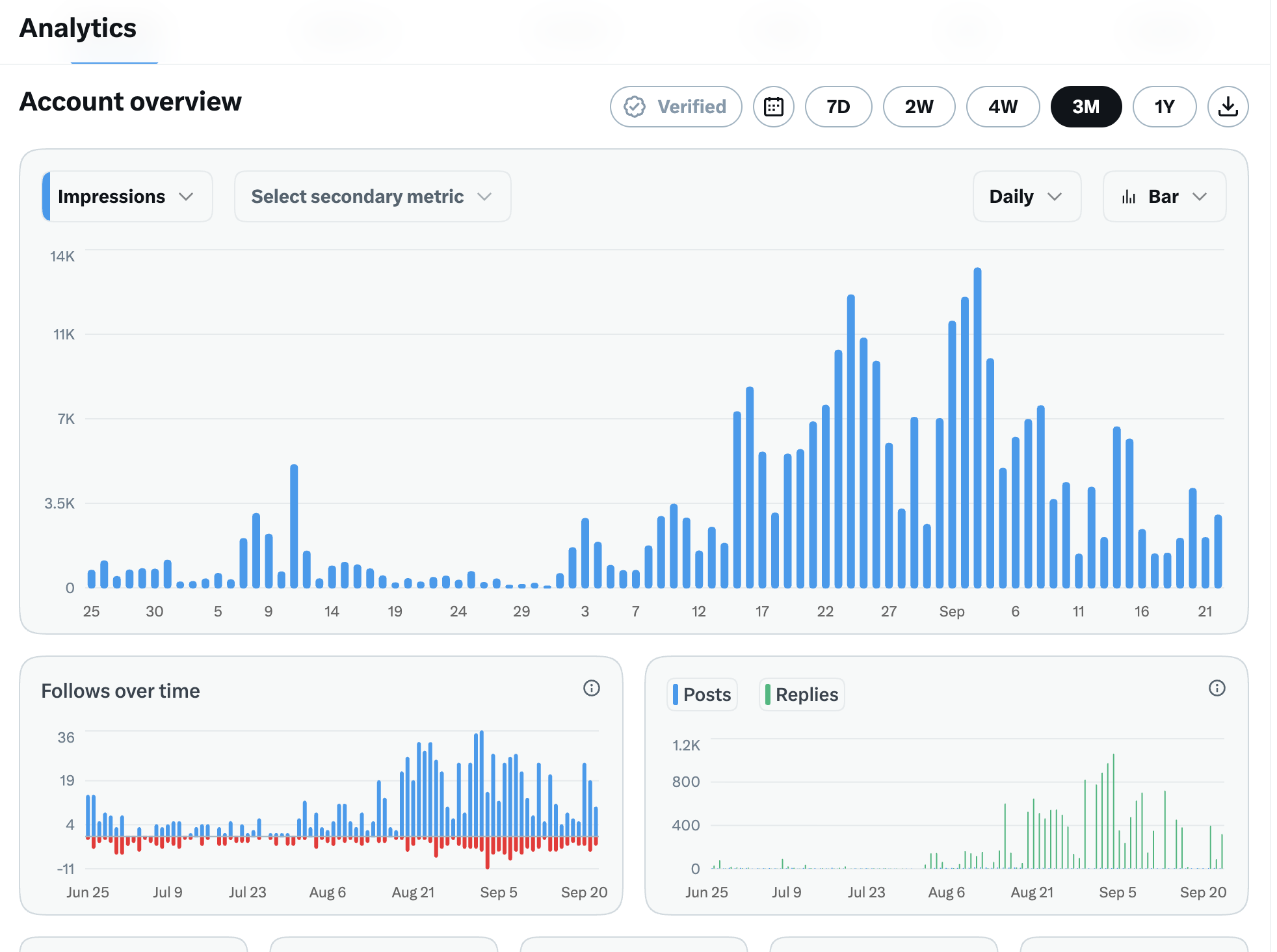
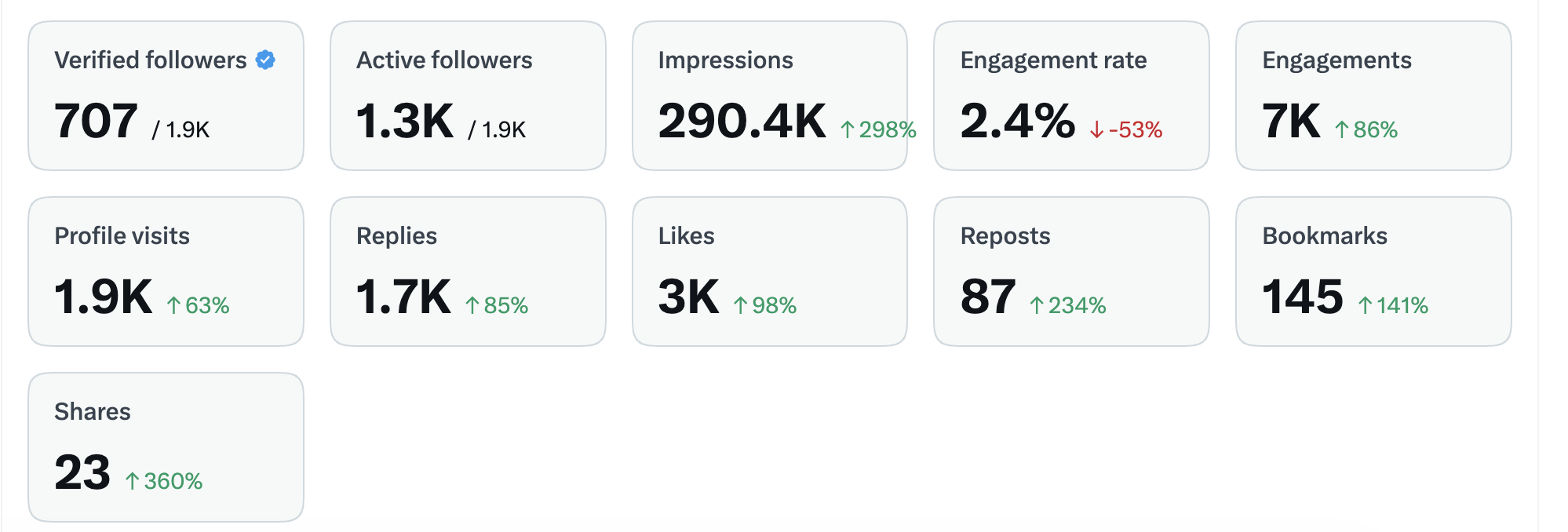
The account had sat near 1,400 followers around June and reached 1,900 by September. On many recent days, the analytics chart shows 10–20 net new followers, with several stronger days above that range.
The cohort also included startup partnerships at Microsoft, AI workflow architects, agency operators, product engineers, SaaS founders, and builders of AI revenue and automation systems. These are audience-fit signals, not claims that every follow was caused by one specific reply.
The useful failures were process failures, not model trivia.
A retired fact passed an automated filter because the filter recognized only certain phrasings of “do not use this anymore.” Two replies were corrected by hand and the rule was rewritten.
Two different posts once led to nearly identical replies reaching the same person. The originality check now evaluates the recipient, not merely the text and source post.
The posting tool also produced three false login failures. It stopped safely before typing anything, but cost three posting attempts. The fault was traced to the session check, documented, and held for explicit approval before changing production code.
Autonomy did not remove management. It made clear management more valuable.
The moat was not the model. It was the arrangement.
The result came from narrow roles, real source material, separation of duties, adversarial checking, and a human who remained accountable for the final act. That is the same pattern I now bring to business workflows: automate the work, preserve the judgment, and make the evidence visible.
Show me your workflow


