The marketing stack that took a team now takes an afternoon
Finding people who had just shown interest in my offer used to mean a data vendor, an engineer to connect the tools, and someone to sort the results. This week I linked a few services together with AI in one afternoon and built a list of 23 warm leads, each with the exact LinkedIn post they reacted to, for less than a dollar in data. Here's what I built, what it found, and what I think it means for small businesses.
If you're waiting on referrals and paying for ads, you may be missing people who have just shown interest in what you sell. They're not hidden. They're scattered across thousands of social media posts, and nobody on your team has time to check who liked what.
Spotting them used to take a data vendor, an engineer and a marketing team. This week it took me one afternoon and less than a dollar.
Among the 23 people I found: the owner of a movers business that's been running for over 20 years, the founder of a new audit firm, and a family doctor who runs their own clinic. None of them contacted me. Each had liked a LinkedIn post about using AI in a small business. A like is no promise to buy, but it's a public, dated sign that the topic is on their mind.
A few years ago, this needed a team
Here's roughly how I'd have approached this a few years ago, next to how I did it this week:
| The job | A few years ago | This week |
|---|---|---|
| Get the data | Sign up with a data vendor, or pay an engineer to collect it | treg, a service that sells public data from sites like LinkedIn for a fraction of a cent per lookup |
| Connect the tools | An engineer, a diagram of how everything connects, and weeks of fixes | An AI assistant (I use Claude) that followed my written instructions |
| Sort the good from the bad | Someone reading hundreds of profiles by hand | Jev, a small AI model that answers yes-or-no questions like "Does this person own a small business?" and says how sure it is. Hundreds of answers cost about a cent |
| Keep track | Exporting spreadsheets into a customer list | Each lead saved straight into Notion, with its evidence |
No single tool got smarter. AI now does the connecting between them, so I spent the afternoon deciding who to find, not wiring systems together.
What I built
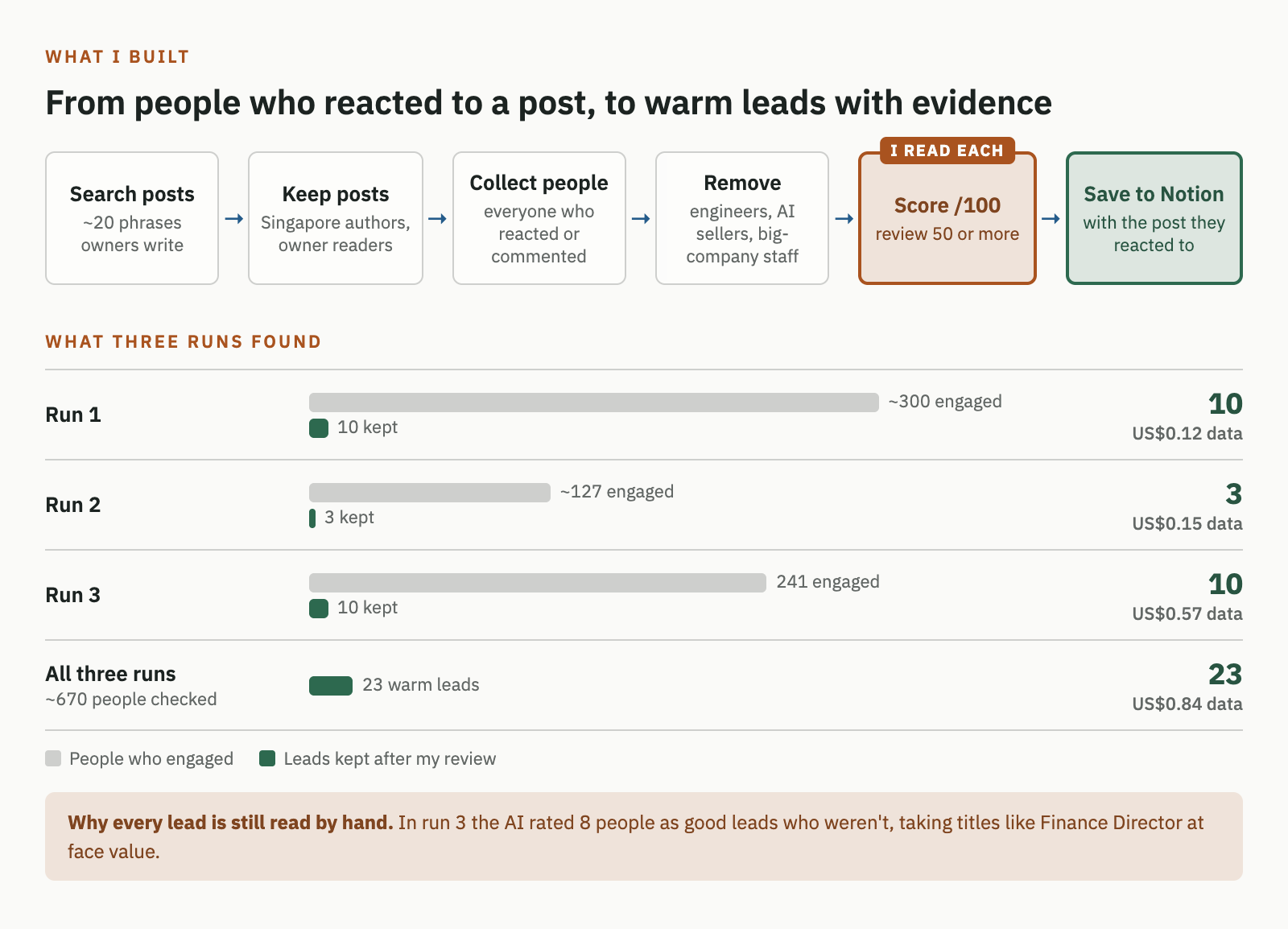
Each run searches LinkedIn for recent posts using about 20 phrases owners actually write, like "ChatGPT small business Singapore". It keeps posts by Singapore-based authors whose readers look like owners, collects everyone who reacted or commented, removes engineers, AI sellers and big-company staff, and scores the rest out of 100 against my ideal customer. I read every lead scoring 50 or more before it's saved. It only reads LinkedIn; it never likes, comments or messages anyone.
What three runs found
| Run 1 | Run 2 | Run 3 | |
|---|---|---|---|
| People who engaged | ~300 | ~127 | 241 |
| Leads kept after my review | 10 | 3 | 10 |
| Data cost | US$0.12 | US$0.15 | US$0.57 |
That's 23 leads for US$0.84, under 4 US cents each, plus about 3 cents for the AI checks. Run 3 also found a work email for 14 of the 18 people it shortlisted.
Some of the people it found (names left out, because they're prospects):
- The owner of a long-running movers business, who liked a bank SME team's post about Singapore owners on a learning trip to China.
- The founder of a new audit firm, who reacted to a post sharing an accounting association's article that quoted their own view of what small businesses need.
- The managing director of a maritime logistics firm, who liked a post about owners not knowing which problem to solve first with AI.
It wasn't right first time. Posts by tech sellers attracted other tech sellers, and the AI took titles like Finance Director at face value: in run 3 it rated 8 people as good leads who weren't. That's why I still read every lead, the "draft for approval" step of the AI Trust Ladder.
Here's what I think this means
This is my view from one afternoon and 23 leads, not a study. But I think three things follow.
Building the system is no longer the barrier. If you've ever thought "big companies have a marketing team, I just have me", that gap got a lot smaller. Work that needed engineers, a vendor contract and a marketing team is now within reach of a small business with an afternoon to spare. Of course, your competitors can build the same list.
Getting attention is still hard. Cheaper data also makes spam cheaper, which is why I argue you probably don't need an AI salesperson. What stands out is a message that shows you paid attention. Compare "Hi, I help businesses with AI" with "I saw you liked the post about which problem to solve first. What would yours be?"
Speed matters more than it did. If you can see interest sooner, you can reply sooner, and replying quickly has long mattered: a 2011 Harvard Business Review study, The Short Life of Online Sales Leads, found that firms which replied within an hour were nearly seven times as likely to reach a real conversation with the decision-maker as firms that waited an hour longer. Finding leads faster won't help if quoting still means typing prices at 10pm. My free Enquiry to Quote tool shows the other side: type the kind of enquiry your customers send, and see it checked and answered with a rough quote in seconds.
What I don't know yet
This covers finding people, not winning them. At the time of writing I haven't contacted any of the 23. I'll add how many replied, and whether it beats the cold lists I've used before.