A go-to-market plan for 30 cents: finding, checking and ranking 35 leads with Claude and Treg
I built a full go-to-market motion for a B2B AI company in about an hour of my own time. The data cost about $0.30. The judgment calls, not the data, decided which leads were worth anything.

I set myself a task: build the go-to-market motion for a B2B company I don't work for. Who should it sell to first, why them, why now, and in what order?
The company sells a platform for building training environments and tests for AI agents, plus a marketplace for training data. Its buyers are AI labs and companies that train their own models. It's a narrow, technical market, which made it a good test. The same cheap-data approach found 23 warm leads from LinkedIn engagement.
I gave it about an hour of my own attention. The data cost about $0.30.
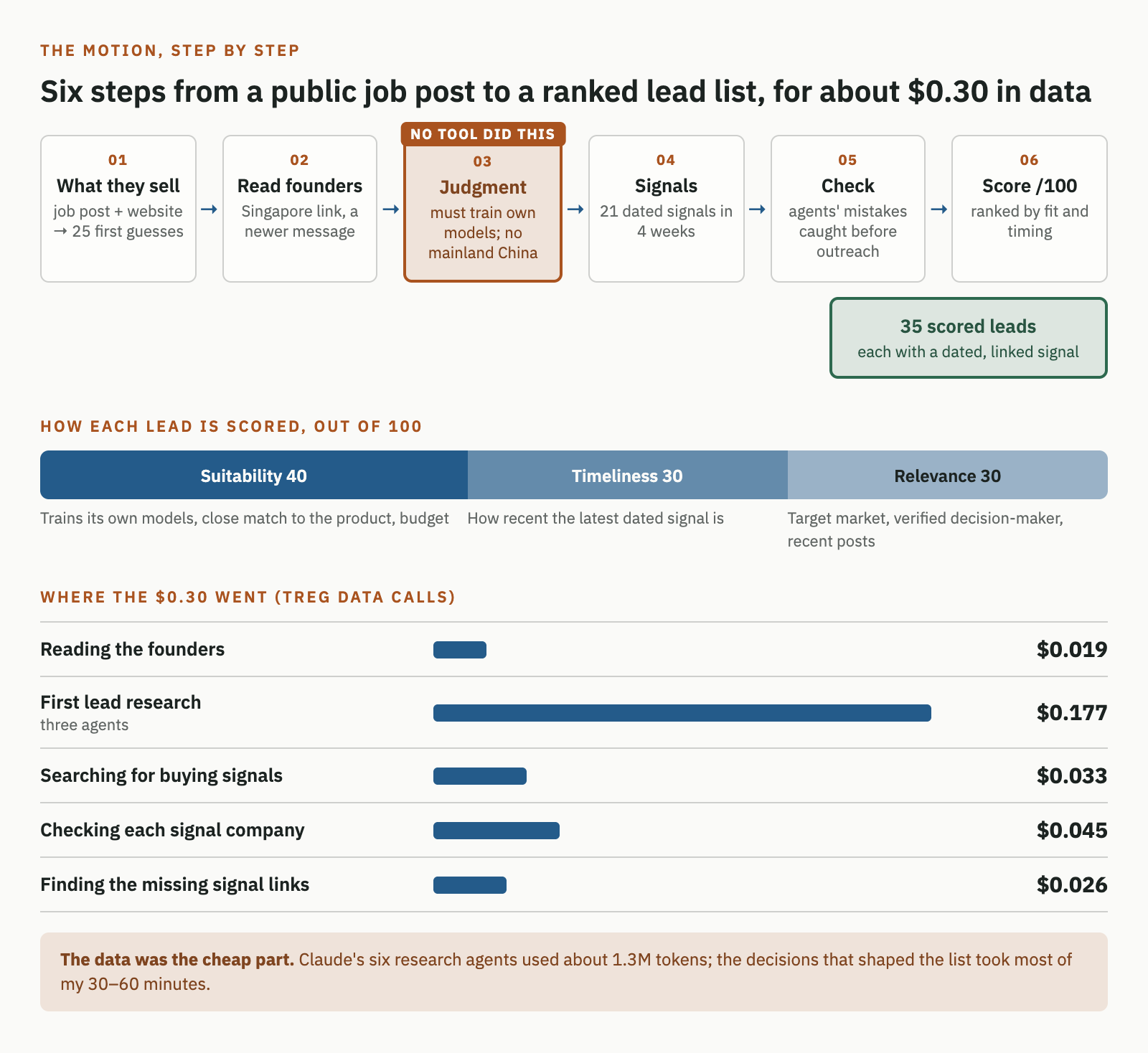
Step 1: work out what they actually sell
I started from two public pages: the company's job post for a go-to-market engineer and its website. From those I listed what it sells, at what price, and to whom. Its own case studies pointed to three kinds of buyer: labs that buy training environments, companies that test their own agents, and data vendors that build on the platform to sell to labs.
That gave me a first list of 25 likely buyers. It was a reasonable list, and it was also a guess. Nothing in it said why now.
Step 2: read the founders, not just the website
Next I looked at the people. I pulled the three founders' LinkedIn profiles and their recent posts on LinkedIn and X.
Two things changed the plan:
- One founder had worked in Singapore. The company was hiring for its go-to-market role in San Francisco or Singapore, and already had research engineers there. That told me Asia wasn't an afterthought. It was where a new hire could add pipeline nobody else was working.
- The CEO's posts and the company's posts said different things. His last posts on X were three months old. The company account, active that week, had moved to a sharper message: train your own open model on your own environments. If I'd pitched from the CEO's older posts, I'd have pitched last quarter's product.
Step 3: apply product judgment before spending anything
This is the part no tool did for me.
Leave out mainland China. The data was there, but a Chinese lab is unlikely to put its training data and environments on an American platform, and selling to one adds export-rule risk for the seller. It's common sense, but a lead-finding tool will happily hand you those names, because they score well on everything except the one thing that matters.
Be honest about robotics. The company had published a robotics benchmark, so robotics firms looked like obvious targets. But it had no robotics customer yet, and its core product was built for software agents. I kept robotics teams only where they train their own robot models, and scored them lower on product fit. A company that only makes robot hardware has nothing to buy here.
A buyer must train its own models. That one rule removed most of the "AI company" names that look right at a glance.
Step 4: find the signals
A good list says who. Signals say now. I looked for four kinds in the last four weeks:
- A launch of an agent that uses a browser or a computer.
- A job post for someone to build training environments or do post-training.
- A funding round that mentions training, agents or robot models.
- A newly published test or benchmark for agents.
That search found 21 dated signals with links. The best were job posts written almost in the company's own language: one team was hiring someone to build "RL environments for long-horizon agentic work". Another, a Korean lab, posted on 30 September for engineers in post-training, RL and evaluation.
Signals also changed the list. Three of my weakest leads had no reason to be contacted this month, so I removed them and promoted three signal companies in their place. Then I reviewed every remaining signal one by one: 11 more cleared the bar, and 4 didn't. Two of those only made robot hardware, one only sold training data (a possible supplier, not a buyer), and one was mostly a robot maker with no sign of training its own models. I also cut one that scored well: a government research agency, which I judged unlikely to buy from a purely American vendor. The list ended at 35, not because 35 was the target, but because that's how many passed.
Step 5: check everything, because the agents get things wrong
I ran the research as parallel Claude agents, one per segment, each with a spending cap and a strict rule: only call a LinkedIn profile "verified" if the name and current company match.
The checking caught real mistakes:
- An agent dropped a strong lead because it confused the company's name with a similarly named existing customer.
- A company's listed website was a parked domain. The real one had a hyphen in it.
- One company's CEO had changed ten months earlier; another's two weeks earlier.
- A "founder" who posted a job turned out to be a founding employee.
- One company's ownership needed a closer look. It was US-headquartered but founded and funded by a Chinese billionaire, which I flagged for a decision rather than deciding silently.
- A line I'd quoted as the company's message was really one founder's post that the company account had reshared. It still worked as an angle, but only credited to him.
- More than half the leads listed a "latest activity" date with no link behind it. The agents had read the post and kept the date, not the URL. Every row now links to the post, launch or article it cites.
None of these were hard to find. All of them would have embarrassed a cold email.
Step 6: score and rank
I scored every lead out of 100 so the list could be filtered, not just read:
| Part | Points | What it measures |
|---|---|---|
| Suitability | 40 | Do they train their own models, how closely does their work match the product, and do they have budget? |
| Timeliness | 30 | How recent is their latest dated signal? Under two weeks scores highest. |
| Relevance | 30 | Are they in the target market, is the decision-maker's profile verified, and have they posted in the last two months? |
The ranking was mostly decided by timing. Several strong fits sat in the middle of the list only because they'd been quiet for months. That's the point of a score like this: it tells you who to contact this week, and who to watch until they give you a reason.
The stack, and what it cost
- Claude did the reading, research and drafting, through six research agents, several running in parallel. Those agents used about 1.3 million tokens and ran for about 32 minutes in the background while I did other things. That figure excludes the main conversation where I made the decisions, so the true total is higher.
- treg, a pay-per-call catalogue of data tools, did the lookups. I didn't sign up to LinkedIn data vendors or scrapers. A full LinkedIn profile cost $0.0015, a person's recent posts $0.0015, a search for the right profile $0.004, and a company's X timeline under a tenth of a cent. I hooked it into the agents as a skill, so they could search the catalogue, read each tool's price, and call it themselves within a budget I set.
- The output was a CSV of 35 scored leads, each with a verified decision-maker where possible, a dated and linked signal and an outreach angle, plus a short report.
Here is where the money went:
| Step | treg spend |
|---|---|
| Reading the founders (LinkedIn profiles and posts, X timelines) | $0.019 |
| First lead research (three agents) | $0.177 |
| Searching for buying signals | $0.033 |
| Checking each signal company | $0.045 |
| Finding the missing signal links | $0.026 |
| Total | ~$0.30 |
The whole data bill came to about 30 cents. A year ago the same research meant a data subscription, a scraping tool and a researcher's week. Now it's a set of API calls, agents that reason and build context, and a GTM engineer steering them toward the buyers who fit.
What I take from it
The data is nearly free now. What decides whether a lead list is any good is a handful of judgment calls: who can't buy, which of the company's bets are proven, which signal means now, and which of the agents' confident facts are wrong.
That's the part I'd want a human doing, and it's the part that took most of my hour.