When usage data contradicted Mindreader's roadmap
At Mindreader, research, product behaviour and cohort data showed the real problem: turning a first insight into a repeatable, paid workflow.
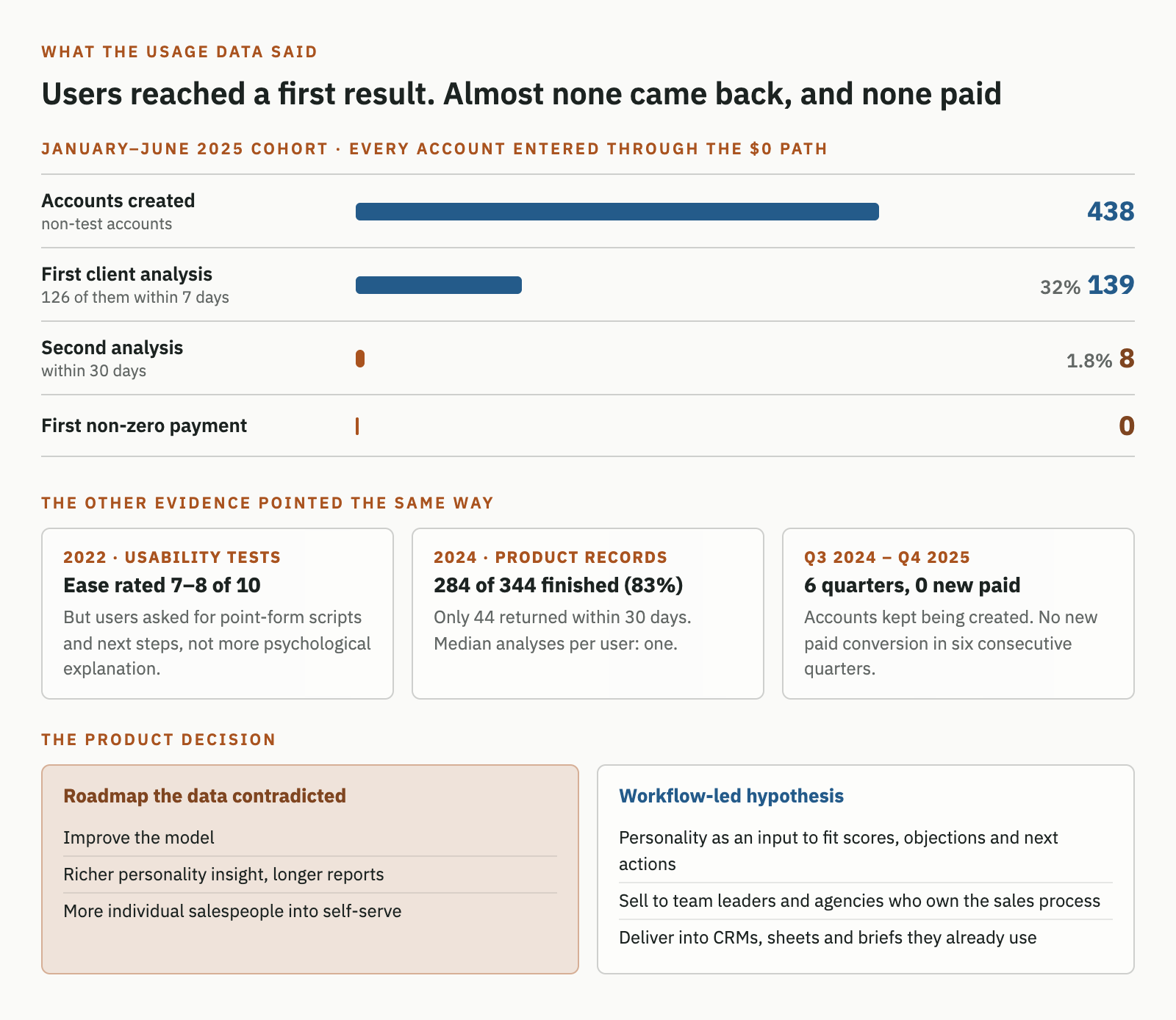
At Mindreader, the roadmap assumed the problem was the model: make it smarter, add more personality depth, build richer reports. The usage data said otherwise. The 2025 free-path cohort went from 438 accounts to 139 first analyses, 8 repeat analyses and 0 new paid conversions.
The product was failing because no one had a reason to come back.
The situation
Mindreader began with a technically coherent thesis: in relationship-driven sales, understanding how a prospect communicates could help a salesperson prepare for an important meeting.
As CTO, I led the technical product at Mindreader, an AI buyer-intelligence company that raised SGD 500K in pre-seed funding. That meant AI models, inference pipelines, confidence rules, backend APIs, the web application, UAT, customer interviews, enterprise prototypes, and facilitated workshops. The reports customers received were my responsibility end to end.
The tempting roadmap was clear:
- Improve the model
- Add richer personality insight
- Make reports more detailed
- Attract more individual salespeople into self-serve
I pursued that direction for a while. Then the usage data made it impossible to defend.
The question I had to actually answer
The goal became not proving the existing idea right, but answering a harder one:
What would have to be true for Mindreader's intelligence to change a real sales decision repeatedly—and who would care enough to pay for that change?
I combined qualitative research, feature behaviour, cohort retention, and payment data. No individual signal was enough on its own.
Evidence 1: users wanted action, not explanation
In usability tests across March and April 2022, participants completed tasks and rated ease around 7–8 out of 10. Two users independently said they would pay SGD 20 per month.
But what they asked for told a different story: point-form sales scripts, concrete next steps, direct guidance.
Not more psychological explanation.
The model produced an insight. The user still had to figure out what to do with it. That gap never closed.
Evidence 2: first use did not create a habit
2024 product records showed 344 people began a client analysis and 284 completed it: 83% completion once they started.
So the core analysis flow was not the whole problem. But only 44 of those users returned within 30 days. Median analyses per user: one.
The self-assessment quiz had 876 submissions in 2024. Only 23 people repeated it within 30 days.
Interest in receiving an answer, once. No evidence of a recurring working loop.
Evidence 3: the funnel was clearer than any user interview
For the January–June 2025 cohort, every one of 438 non-test accounts entered through the $0 path. I followed the full journey:
438 accounts created
      ↓
139 completed a first client analysis (32%)
      ↓
8 completed a second analysis within 30 days (1.8%)
      ↓
0 made a first non-zero payment
126 of the 139 activated users reached their first result within seven days.
The issue was not that users never got to value. A meaningful share did.
Almost none came back. None paid.
Before
Acquire more individual users and give them a better standalone personality report.
After
Make the output useful inside a repeating team workflow, then test whether that workflow earns adoption and payment.
Evidence 4: signups were not a signal
Six consecutive quarters. Zero new paid conversions. Accounts were still being created throughout.
The data did not say the model had no value. It said the self-serve product had not made that value repeatable or commercially compelling.
Treating a completed report or a positive demo as proof of product-market fit would have hidden the actual problem.
The diagnosis
Four connected issues, once I stopped defending the roadmap.
The output stopped too early
A personality profile explained something. It did not complete the job. The useful endpoint was a decision: who to prioritise, what objection to explore, or what to say next.
The product lived outside the workflow
Salespeople worked in CRMs, WhatsApp, spreadsheets, and call notes. A separate report created another translation step: easy to try once, easy to abandon.
The user and buyer were different people
Individual agents felt the pain. Team leaders, agencies, and sales-enablement functions had the incentive to pay—and the scope to apply an insight across many sellers.
The roadmap chased the wrong problem
Model quality still mattered. But a more accurate prediction would not, by itself, make a separate dashboard part of someone's working day.
The product decisions
1. Treat personality as an input, not the product
The direction moved toward fit scores, buying signals, objection risks, and next actions. Personality contributes, but it is not what the customer needs to understand.
2. Move to a system-level buyer
The next buyer hypothesis became agencies, team leaders, training managers, and lead platforms: organisations that already owned a sales process and could apply an insight across many sellers.
3. Deliver into existing work
I built workflow-specific demonstrations for prospective partners: candidate-fit screening, sales coaching, and CRM-ready briefs. The delivery hypothesis was batch enrichment through CRM fields, CSV, Google Sheets, API responses, and sales briefs. A Mindreader workspace would be a fallback, not the destination.
4. Stop treating features as progress
I deprioritised longer reports and model work that could not connect to an observable business decision or repeat behaviour.
What I chose not to claim
This did not immediately create product-market fit. The B2B direction had not yet demonstrated measurable sales lift through a controlled pilot.
The database does not prove why an individual user did not return. It proves the pattern that required a different hypothesis.
The defensible outcome:
- The product problem became measurable, not anecdotal
- The end user and economic buyer were separated
- Low-value roadmap work was stopped
- Prototypes tested workflow-led use cases
- The next product question became smaller and falsifiable
The next experiment
The next test should not ask whether customers like another report. It should compare a real sales workflow with and without the intelligence layer.
For one team, in the same period:
- A normal control group
- A group receiving scored and enriched leads
- Recommendations delivered inside the team's current tools
- Measurement: reply rate, booked meetings, reply-to-meeting conversion, repeat use, and team adoption
That experiment could falsify the new direction. That is the point.
A useful product decision produces a smaller, clearer, and cheaper question for the market to answer.