Mindreader: AI sales intelligence for teams at AIA, CIMB and Manulife
Mindreader gave sales teams at AIA, CIMB and Manulife a read on each prospect before the first meeting, backed by ~SGD 500K in angel funding and IBF-recognised training.
Mindreader's sales system was rolled out to AIA teams in 2023, and a CIMB relationship-manager team used it together from March to August 2025: a one-page read, before the first meeting, on how a client probably prefers to be spoken to. In financial advice, that first meeting often decides the deal.
Mindreader is an AI sales-intelligence company for relationship-driven sales in insurance, banking and financial advice. Its clients have included teams at AIA, CIMB and Manulife. I have been its CTO since 2021.
The institutions behind it
- Clients. Teams at AIA, CIMB and Manulife, and individual advisors at Great Eastern.
- Funding. About SGD 500K raised from angel investors in 2023. Investors include a district director at PropNex, Singapore's largest listed real-estate agency, and a venture builder who helped lead a company The Straits Times named among Singapore's fastest-growing in 2019.
- The framework. The Human Intelligence System (HIS), Ethan Lin's adaptation of psychologist David Keirsey's temperament model, used to train salespeople at DBS Bank, AIA, Prudential and PropNex. Ethan also runs Personality Central, a personality-science site with 22.3 million Google search impressions and nearly 50,000 search visits in the 16 months to October 2026 (Google Search Console).
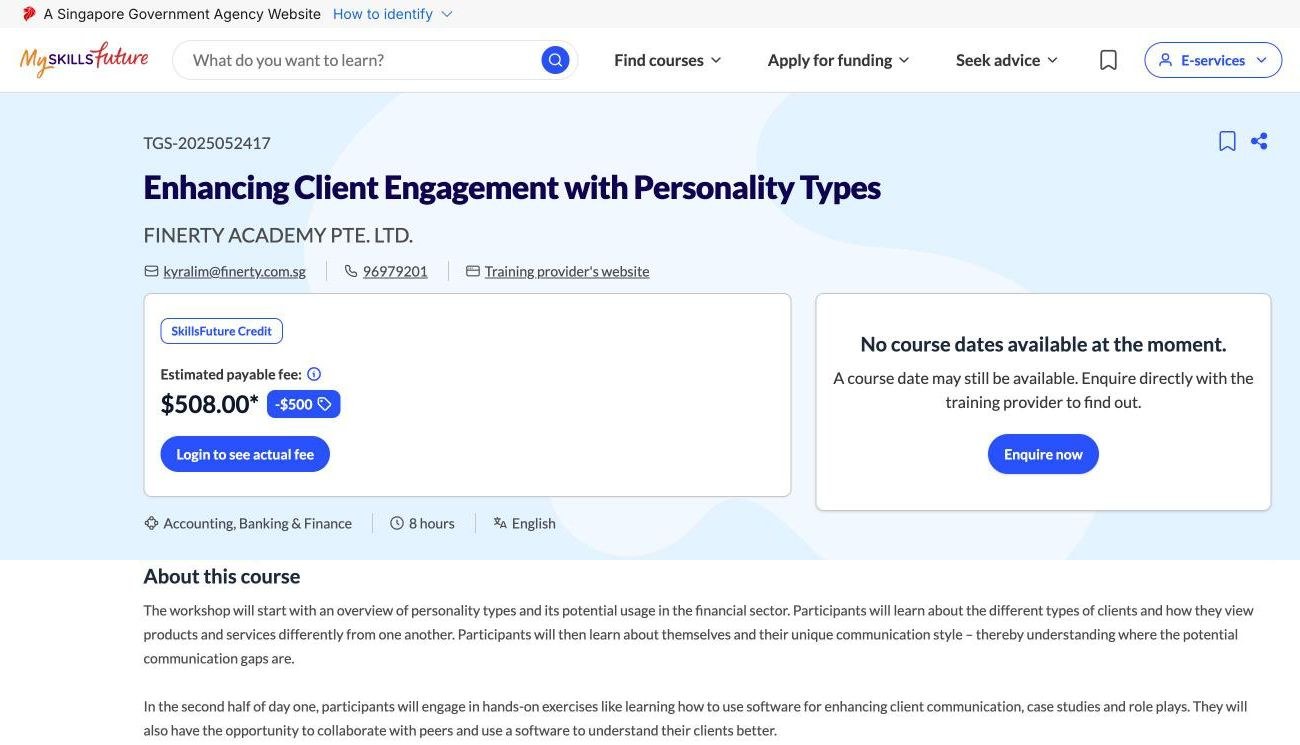
- Training accreditation. I co-developed a personality-based communication training programme listed under SkillsFuture, Singapore's national continuing-education framework, and recognised by the Institute of Banking & Finance Singapore (IBF).
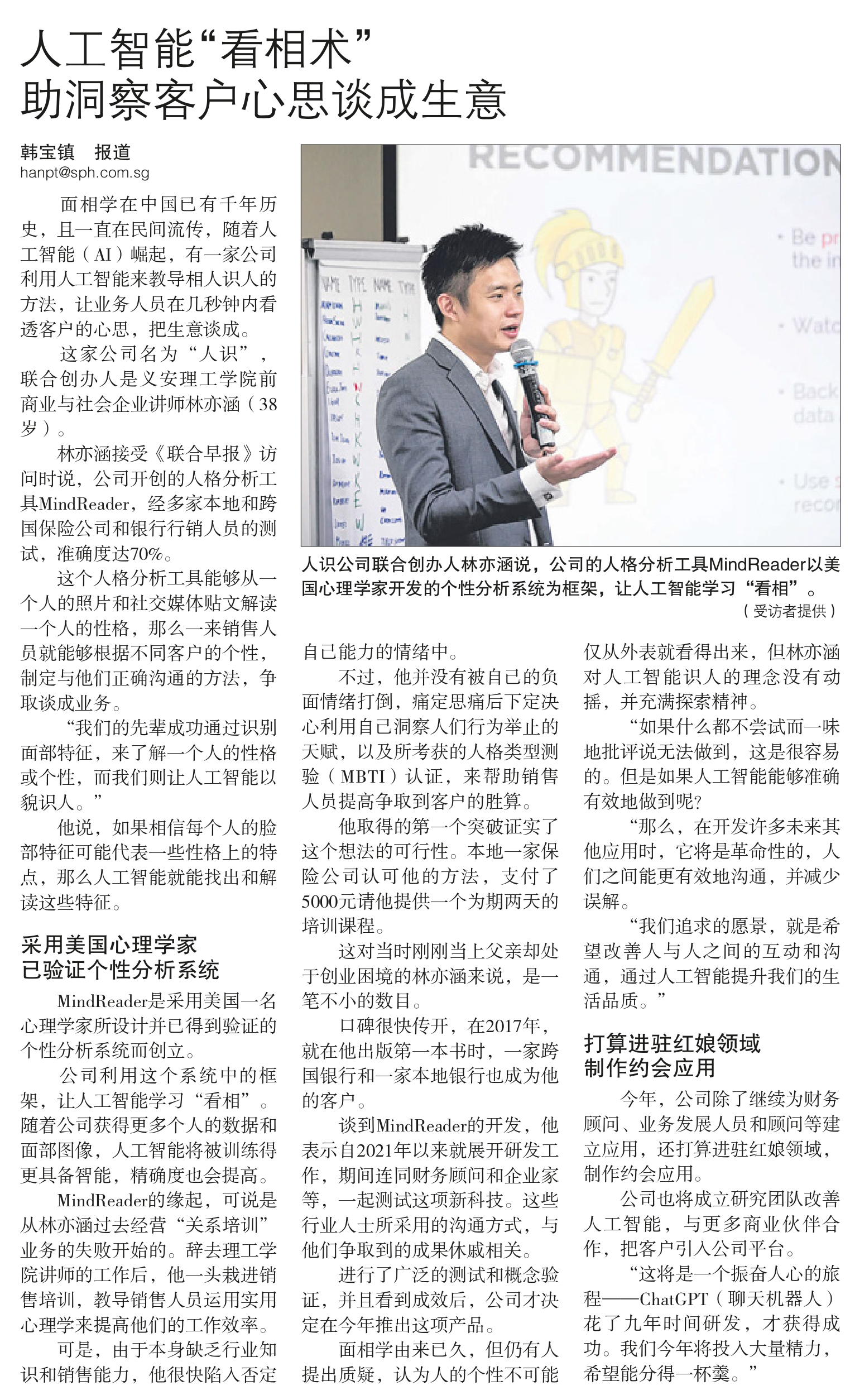
- Press. Covered by Lianhe Zaobao (March 2023), CNA938 and Money FM.
Startup programmes. Mindreader was accepted into five:
 YC Startup School
 Google for Startups
 Microsoft for Startups
 AWS Activate
 SMU BIG incubator
The constraint
In relationship-driven sales, the first meeting decides a lot. Good advisors read people well and adjust how they open, how much detail they give and how hard they push. Everyone else guesses. Mindreader's job was to give a salesperson a practical read on a prospect's communication style before that meeting, with specific advice on how to open, what to emphasise and what to avoid.
Three things made that hard:
- The prediction is uncertain by nature. Inferring communication style from a photo or a few lines of text will sometimes be wrong. In regulated sales at banks and insurers, a confident wrong read can do more damage than no read at all.
- The user has minutes, not hours. Advisors check their phones in the car park before a meeting. Anything longer than a one-page brief does not get read.
- The budget and team were small. About SGD 200K went on engineering over three years, with a team of ten across Asia at its largest.
The model
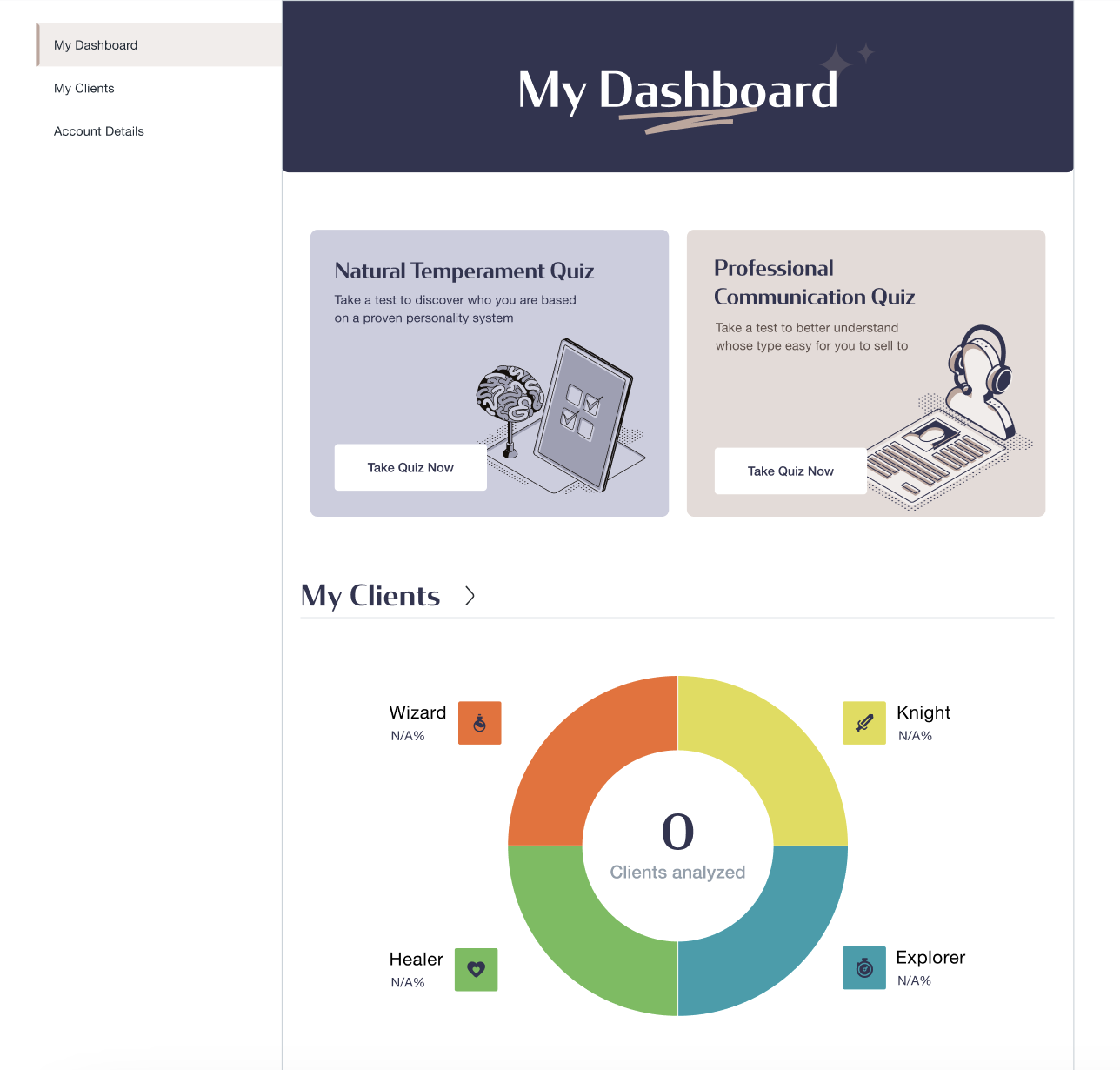
HIS adapts psychologist David Keirsey's temperament model, from Please Understand Me (1978) and his Keirsey Temperament Sorter: Keirsey's Guardian, Artisan, Idealist and Rational become Knight, Explorer, Healer and Wizard. Personality Central's write-up gives three reasons it suits sales better than the usual alternatives:
- Four types a salesperson can remember. MBTI has 16 types and the Enneagram nine. Four can be learned in one workshop and used mid-conversation.
- It sorts people by what they want, not only how they act. Keirsey grouped people by core needs and values, which tell an advisor how to open. DISC measures observable behaviour, and the Enneagram has no clear link to selling.
- It connects to the established tests. Each MBTI type maps to one HIS type (ISTJ is a Knight), and Big Five results convert too, which is what made outside validation possible.
Ethan, Mindreader's co-founder and now its strategic advisor, spent about eight years adapting it for sales and is MBTI-certified through CPP Asia Pacific (on test validity). The engineering problem was turning it into a prediction, then into an action.
It started with text. The 2021 model inferred a prospect's type from their public social-media posts, trained on thousands of labelled English-language posts. In the field, advisors often couldn't get enough of a prospect's writing: many clients post rarely, privately, or share others' content. A model that needs data the user can't collect does not get used.
So the second model reads a photo, the one thing an advisor almost always has. The first face model launched in September 2022; the second took six to seven months and 13 iterations with a team of three. It combines three kinds of features in one model: face-recognition embeddings, facial action units (the standard coding of facial muscle movements), and coordinates from a 3D reconstruction of the face. It was trained on about 2,000 hand-labelled images, plus around 40,000 publicly available face images with weaker labels, covering at least 50 demographic groups by gender, ethnicity and age.
Then a rule for how sure it is allowed to be. Every reading, from a photo, text or a quiz, updates one running estimate of the person's type. The trade-off was coverage against trust: the second version asks for three photos and warns users before analysing just one. That adds friction for a real gain. On Mindreader's internal test data, the second model's top two picks contained the right type 70% of the time from a single image and 85% when three or more images were combined, which is the 70–85% accuracy range Mindreader used in its marketing. The independent test below is the stricter check. A short text sample could never produce a "very confident" result, and neither could a close call between two types. (The same principle is behind Two kinds of decisions.)
And every reading becomes an action. In March–April 2022 usability tests, participants rated the tasks 7–8 out of 10 for ease but asked for point-form scripts, not more psychology. So each reading became three instructions: how to open, what to emphasise and what to avoid (for example: lead with the result; emphasise numbers; skip the small talk).
How the face model was validated
In 2024, Mindreader tested the face model on an independent group of 60 people, with 174 photos between them. Each person also took two third-party tests: the 16Personalities (MBTI) test and Truity's Big Five test. Both results were converted into HIS types and compared with the model's predictions.
| Question | Chance | Face model |
|---|---|---|
| Do the model's top two types include one of the person's top two? (vs MBTI) | 75.1% | 81.0% |
| Do the model's top two types include one of the person's top two? (vs Big Five) | 75% | 89.6% |
| Does the model's single top pick match the person's main type? (vs Big Five) | 25% | 36.2% |
Every result beat chance at p < 0.05. The honest reading: the model is a useful hint, not a verdict. Its single top pick is right about a third of the time, against a quarter by chance, which is why the product shows confidence and advice for more than one type rather than a single label.
The system
The CTO role covered the technical product end to end:
- The prediction service. The models run as a separate service (a Flask API with TensorFlow Serving behind an Nginx proxy), so the app, partner integrations and later products could all call the same prediction. A face reading took one to five seconds on the first model.
- The web app. The first web app shipped in 2022 with a confidence bar from day one, followed by a mobile result designed to be read in under a minute. The face model went into the app in 2024.
- Automated reports. A one-page pre-meeting brief, plus a quiz-based "fiscal personality" report that clients filled in themselves and advisors used to start a conversation.
- Delivery. Testing with real users at enterprise sales teams before each release, and the 2023 rollout to AIA teams.
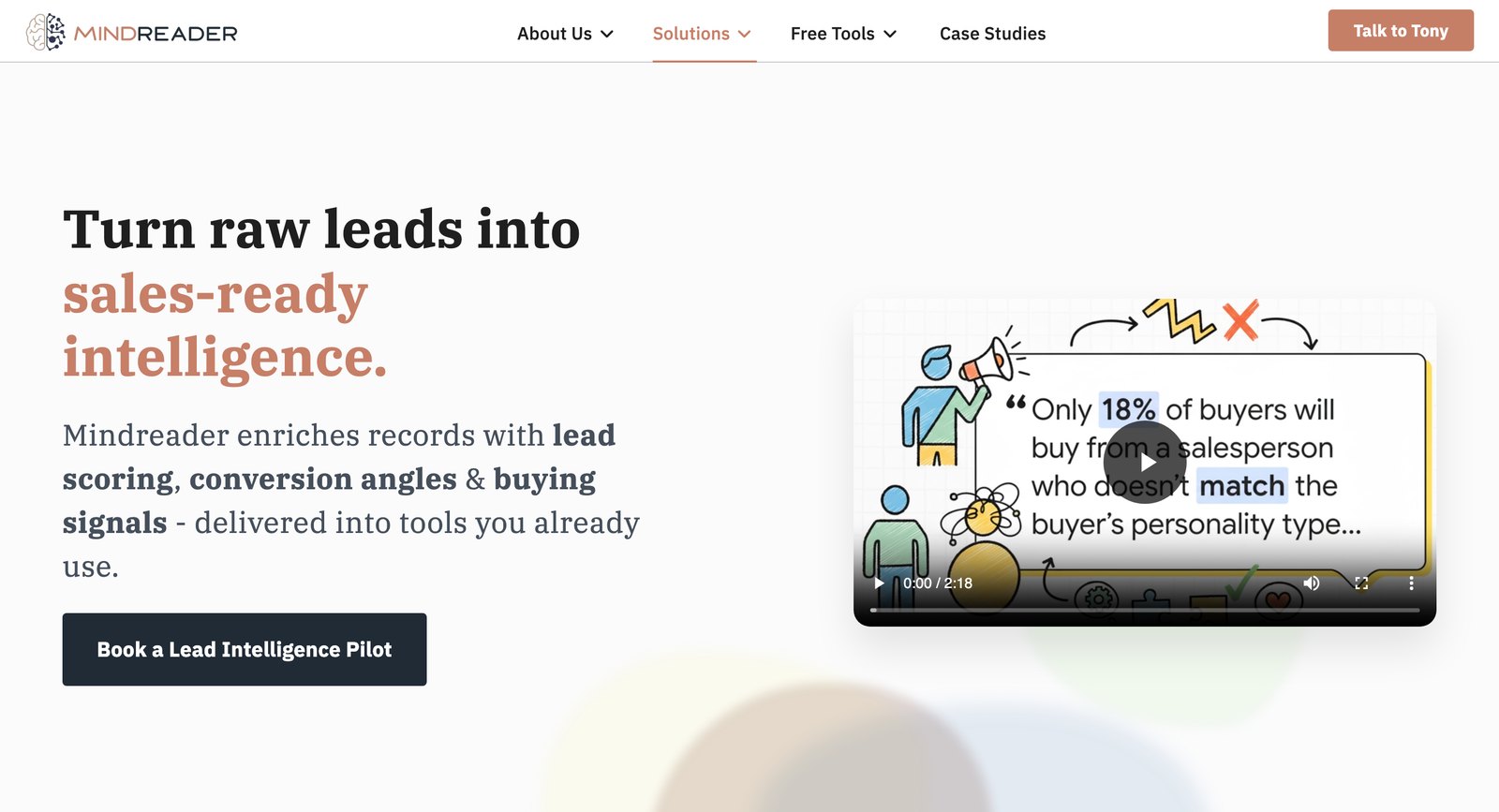
Because the prediction sat behind its own service, the same model could serve several products: the sales app, a direct service for developers who wanted the prediction without the app, and a consumer face-scanner app.
The result
- At least 15 workshops for AIA sales professionals in 2021–2022, reaching hundreds of advisors, and a rollout of the sales system to AIA teams in 2023.
- AIA training sessions in March and April 2023, led by Ethan Lin as lead trainer, were rated 4.8–4.9 out of 5 in participants' post-session evaluations, and every respondent said they would recommend them.
- 100+ paying customers over the company's life, including enterprise sales teams, and 3,000+ user accounts across five countries (Mindreader account and billing records).
- A face model that beats chance on the 2024 test of 60 people against two third-party personality tests, as shown above.
The limit. Advisors rated the app 7–8 out of 10 for ease in the 2022 usability tests, and the 2023 AIA training scored 4.8–4.9 out of 5, but self-serve users rarely came back after the first reading. Mindreader's own account data shows it: of 438 free accounts created in January–June 2025, 139 completed a first analysis, 8 did a second within 30 days, and none paid. A reading on its own did not become a weekly habit. Mindreader is now moving away from the self-serve SaaS model and towards AI services, helping sales-led teams build the workflows, lead scoring and follow-up systems that make a reading useful. The cohort numbers behind that change are in When usage data contradicted the roadmap.
What advisors reported
Two advisors who learned HIS through Mindreader's training, quoted from Mindreader's published case studies. The figures are their own:
Before, my conversion rate was 20-30%. After learning HIS, my conversion rate has increased to 50-60%. After learning HIS, I still use it 4 years later, especially during case studies with my team.
 Ong Shan QingSenior Financial Consultant, MDRT 2020 and 2022
My conversion rates have increased 10-15% for both qualified and non-qualified leads after using HIS.
 Hazel YeoIBF Qualified in Private Banking & Wealth Management, AIA Million Dollar Gold Club
And on the software itself, from the same published case studies:
Mindreader's AI-driven insights and preparation tools have completely transformed my workflow, making it easier to focus on what matters most: building relationships and closing deals with a clear, tailored strategy.
 Nicholas TeoMDRT Financial Advisor, Great Eastern