158 Singapore businesses got a website enquiry. 1 in 6 replied within 5 days.
A buyer-style enquiry went through the website contact forms of 158 Singapore small businesses in one day. 26 replied within five days, 12 forms could not take an enquiry at all, and only 2 of the 12 firms that promised a reply time kept it.
On Tuesday, 13 October 2026, a Flareworks field test sent one enquiry through the website contact forms of 158 Singapore small businesses. It read like a normal customer: a few lines tailored to the trade, asking for a rough price range or how the process works, and saying "just gathering info for now".
Five days later, 26 of them had replied. That is about 1 in 6.
What the test was, and why it was run this way
The firms came from the Flareworks lead list: renovation and interior design, carpentry, movers, plumbers, electricians, aircon and handyman services, plus some legal, corporate services, training, signage and manufacturing firms. The submissions ran from 11.46am on the Tuesday to 1.31am on the Wednesday.
Every enquiry used my real name, real email address and real phone number. There was no intent to buy. The point was to measure how long a reply takes, and that only works if the business doesn't know it's being measured. A firm that knows it's in a test replies differently.
A few rules kept it fair:
- Clinics and medical firms were skipped on purpose. A fake medical enquiry can take a slot from a real patient.
- Forms that needed more than a message were skipped. CAPTCHAs, required uploads or addresses, and forms that hand you off to WhatsApp. That was about 1 in 4 forms.
- One enquiry per firm. One firm got two by mistake, so it was 159 submissions covering 158 firms.
A week later, I emailed every firm I had an address for to explain what the test was and why it was run.
The numbers
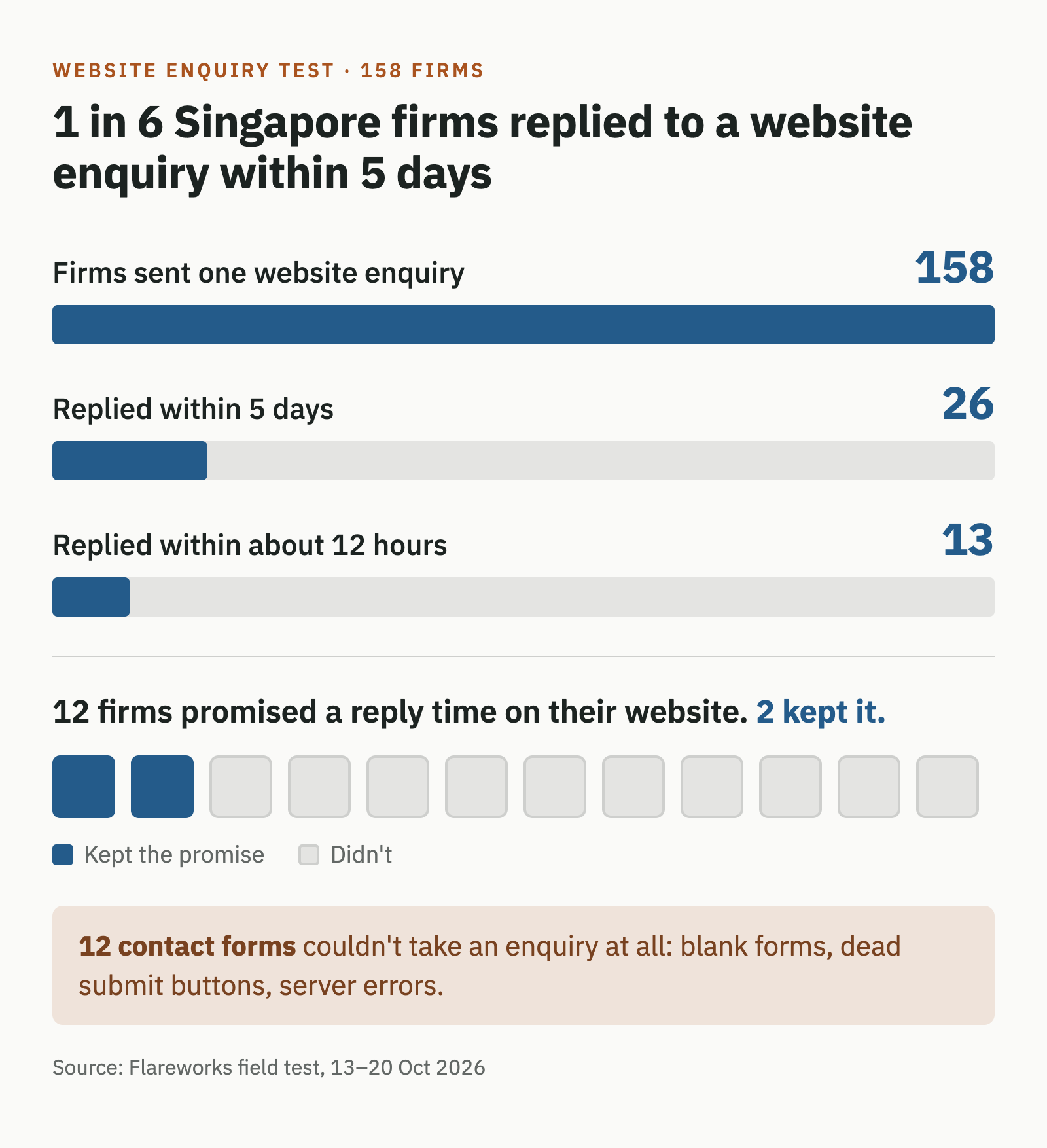
Of the 26 replies, 22 came by email and 4 by phone or WhatsApp.
Half of the repliers, 13 firms, answered within about 12 hours. The fastest real reply took about 15 minutes. Two more firms replied after about six and a half days, after the five-day mark but before the one-week follow-up.
Some responses look like replies but aren't:
- 3 firms sent an autoreply and nothing else. An autoreply confirms the form worked. It doesn't answer the question, so it isn't counted as a reply.
- One reply was a holding note saying a sales rep would follow up.
- One reply came through a referral. The firm passed the enquiry to a partner, who replied after about 62 hours.
For comparison, the first checkpoint was set at 42 hours, the average response time in the Harvard Business Review study covered in Reply first, but reply right. That study looked at US firms in 2011. This one is smaller and local, but the shape is familiar: a handful reply fast, and most don't reply at all.
What the replies had in common
Every firm that replied did the same basic thing: a person read the enquiry and answered it. Half of them did it within about 12 hours.
The gap between them and the rest isn't clever software. It's whether an enquiry reaches someone who acts on it. An autoreply proves the form sent something somewhere. Whether anyone is watching that inbox is a different question.
The promises nobody kept
Twelve of the firms said on their own websites how quickly they reply:
| Promise on the website | Firms |
|---|---|
| Within 15 minutes | 1 |
| Within 1 working hour | 1 |
| Within 24 hours | 5 |
| Within 1 business day | 2 |
| Within 1 to 2 working days | 3 |
Only 2 of the 12 kept the promise. The firm that promised 15 minutes and the firm that promised one working hour never replied at all.
A promised reply time is a good thing to put on a website. Customers like knowing what to expect. But a promise nobody measures is just a sentence, and a customer who was promised 15 minutes and heard nothing has a worse impression than one who was promised nothing.
The forms that couldn't take an enquiry
Twelve forms were broken. They couldn't receive an enquiry at all, so those firms never had the chance to reply. What went wrong:
- The form rendered blank.
- The submit button did nothing.
- The form returned a server error.
- The form said "form disabled".
- A phone field accepted only 8 characters, so the form couldn't be submitted.
- The form was a leftover template from a different company.
- The form failed with "Nonce verification failed", a security check that had broken.
None of these are hard to fix. All of them are invisible to the owner, because a broken form doesn't send an error to anyone. It just goes quiet, and the business assumes nobody is asking.
The filter that ate a real enquiry
The follow-up email turned up a different kind of leak. One firm replied within minutes. The original enquiry, they said, "was flagged as a suspicious entry in our system", and all enquiries get vetted before they are assigned to anyone.
So the form worked. The enquiry arrived, with a real name, a real email address and a real phone number. Then a vetting step quietly set it aside, and nobody was told.
Spam filters and manual checks exist for good reasons. Many small businesses get plenty of junk through their forms. But a filter that can drop a real customer without anyone noticing is costing you leads you will never know about. The only way to find out is to test it.
The limits of this test
The results come with honest caveats.
- The list leans slow. These firms came from a lead list, and some were chosen partly because public reviews suggested they might be slow to reply. So this sample probably has more slow repliers than a random set of Singapore small businesses would.
- One enquiry per firm. A firm could have had a bad week. One message isn't a verdict on a business.
- Email and forms only. Many Singapore small businesses run on WhatsApp, and some of these firms might have answered a WhatsApp message faster. I also didn't check the phone number used during the test, so phone and WhatsApp replies may be undercounted.
- One weekday. Every enquiry went in on the same Tuesday, many of them in the evening. A weekday morning enquiry might have done better.
What the test does show is narrower and still useful: if a customer uses the contact form on your website, there is a real chance nobody answers.
What to check in your business this week
These take about an hour, and you don't need any new software to do them.
- Send yourself an enquiry through your own website form. Use a personal email address and phone number, not your work ones. Note the time.
- Check it arrived, and where. Which inbox did it land in? Who reads that inbox, and how often? If the answer is "nobody in particular", that's the leak.
- Check the form on a phone. Fill every field, including a phone number with +65 in front. Press submit and make sure you see a confirmation.
- Look in your spam folder and any vetting queue. If your form or email has a filter, see what it set aside in the last month. Real customers are sometimes in there.
- If your website promises a reply time, measure it. Write down when the test enquiry went in and when someone replied. If the gap is longer than the promise, change the process or change the promise.
- Set up an instant acknowledgement and an alert. The customer gets a short confirmation straight away, and the right person gets a notification on their phone, not just an email to a shared inbox.
The acknowledgement buys you a little time. It doesn't replace the reply. The reply is what wins the job, and the faster and more useful it is, the better. For how to decide which enquiries deserve a fast answer and which need a person, see Reply first, but reply right.